.
.
.
.
.
.
.
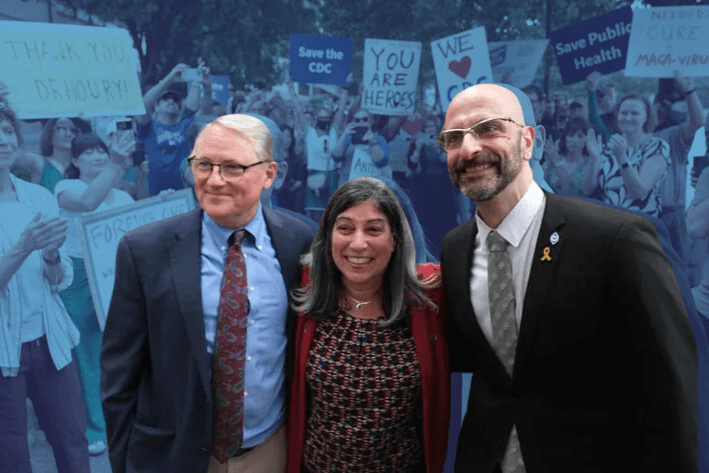
Dr. Daniel Jernigan, Dr. Debra Houry and Dr. Demetre Daskalakis at the CDC walkout, August 28, 2025 (AP Photo / Ben Gray).
Built to Protect: The Future of Public Health
SAANVI HITLAMANI
CONTRIBUTOR
On October 10th, 2025, a great upset occurred within our nation’s top public health administration. A wave of firings crashed into the CDC (Centers for Disease Control) and more than 1,300 staffers ended up without jobs. These individuals worked in several different departments; being doctors, scientists, epidemiologists and many others. Simply put, they were our nation’s officials that ensured the health of all individuals was protected. Public health as a whole has long been a system that works intensively to protect citizens globally. It is because of public health infrastructure that epidemics, pandemics and outbreaks are prevented. It is because of public health that lives are continually saved from infectious diseases, that harm reduction programs can be implemented to stop overdoses, that communities are given resources to address our changing world- including climate change, mass shootings, and rising mental health crises. All the work public health officials worldwide have done is evident when we examine how the COVID-19 pandemic was addressed, the containment of SARS in 2003, the response to HIV/AIDS in the 1980s and the eradication of smallpox, great diminishment of polio, encouragement of immunization and vaccination throughout the past century. The work that public health officials in the U.S and globally do everyday and for the greater good of all of us cannot be overstated.
So, how is it that so many lost their jobs at the CDC? The crisis had stemmed several months prior, when prominent directors such as Dr. Nirav Shah retired with the changing administration starting in February to March. Massive funding cuts had been put into effect beforehand, affecting several federal institutions. In the NIH (National Institute of Health) itself research grants equal to 3.8 billion dollars of funding had been terminated. In April, the department of Health and Human services also endured massive cuts to their staff. In the CDC, mass reductions and the assignment of new officials caused unrest, and following these massive changes, more and more prominent officials were leaving, largely due to extremely controversial changes on policies; especially relating to vaccines. For example, the CDC’s Advisory Committee (that focuses primarily on vaccine recommendations) had been disabled. The cuts were impacting fields that are crucial for American health; and worst of all, there was little to no information coming out about it. Employees in the CDC did not feel they could trust the system that caused so many of their colleagues and friends to lose jobs overnight. Several leaders were walking out in protest. The state of affairs was, to be frank, bleak. Or, in the words of Dr. Demetre Daskalakis who was director for the CDC’s National Center for Immunization and Respiratory Diseases; “CDC is over. It was killed.” Yet, is that really true? Was the CDC dead? On a larger scale- was Public Health too? Simply put- no; but the difficulties did not end there.
Summer of 2025 was an extremely tense and difficult time for all those in the field. In August, a gunman opened fire at a CDC building and claimed the life of a responding police officer. He had believed that vaccinations were harmful. His actions against those in service was due to misinformation that was unfortunately being supported by the newly assigned officials in public health. It was a clear, intense statement that when true science is not being honestly shared with the public, and health becomes heavily politicized, violence can be bred. Shortly after this tragedy, the appointed director of the CDC, Dr. Susan Monarez, had resigned. In an act of protest, she and several other officials stated powerfully that they were standing up for science. The loss of so many leaders only added to the chaos, and brought fear, with statements such as "The CDC is being decapitated. This is an absolute disaster for public health," from Dr. Robert Steinbrook. Yet, as much of an intense issue it was, it showed promise for the future. As Monarez and others took a stand, so did researchers across the country. Stand Up for Science was a movement that swept the nation, and called for science and democracy to prevail. What Monarez and so many others were standing up for were vaccinations, evidence and public health representation. That was now heavily under attack.
The greatest promise that public health gives civilians is access to factual, scientifically proven information about their own wellbeing. The power of this information is that it grows; researchers with access to funding contribute more and more and minorities such as people of color, women, and the LGBTQ+ community can gain representation which is so crucial when it comes to health. When factual, scientifically-proven information is not available to the public; it becomes a failure of public health. This is what has been happening this year. Research with words such as “gender, transgender, pregnant person, pregnant people, LGBT, transsexual, non-binary, nonbinary, assigned male at birth, assigned female at birth, biologically male, biologically female” (as provided by the Columbia Law website) is being retracted by the CDC. This has been widely viewed as censorship, but put in another way this is a restriction of health information. Several researchers from the NIH have been removing such keywords from their research for fear of not being allowed to publish. It is today that all of us learn what happens when those allowed to prevent research from reaching the public are put into power; research that benefits them is released. The greatest harm in all of this is that it never reaches the eyes and ears of the public. News released about the censorship in research, shooting at the CDC, budget cuts and unrest within the system is scarce. It is hidden, and it makes it hard for any of us to understand the full extent of it. Being informed is a civic duty but being informed in a time where administrations lack transparency is a challenge; yet it is still necessary.
Vaccine misinformation has been on the rise. Evidence that supports vaccinations have been removed from websites such as the CDC’s. As a whole, the changes public health is facing today makes it easier for false claims to reach the public; and the risk of doing so is immense. Anthony Fauci is well-known for being the director of NIAID (National Institute of Allergy and Infectious Disease) and chief medical advisor of the United States; one of his famous statements goes “follow the science.” That is where the future of public health lies; a reinstation of faith, and reliance on honest, based science. Currently, vaccination rates have been going down. We see this with the rise of diseases believed to be nearly eliminated such as measles. Measles is preventable and the prevention is within vaccines. The influx of cases in areas such as West Texas in August of 2025 showed that we no longer “follow the science”, and the deaths of two children is an abhorrent display of failure. Lives cannot be lost when there is another option. Misinformation has a heavy price to pay. Public health’s priority has always been with the people; the decline we have seen in this year has not shown as much.
Overall, from budget cuts to protests, resignations and censorship, a rise of infectious diseases and attacks on vaccination, our nation’s public health field has had a very difficult year. Yet, it does not mean in any way that it is over. Public health has always been more than the institutions that are in power; it is the conscious decisions we make to keep ourselves and our families safe by trusting medicine, scientists and decades of research. Public health is the hardworking officials in every state and region across the world who endure the tough conditions in order to keep people healthy. The field has had several successes this year as well, ones that everyone should be aware of, and it will only grow. Public health is about safety, security and courage; if nothing else, with the decline this year, courage has only grown. I know it will continue as we face whatever is next in the coming year.